


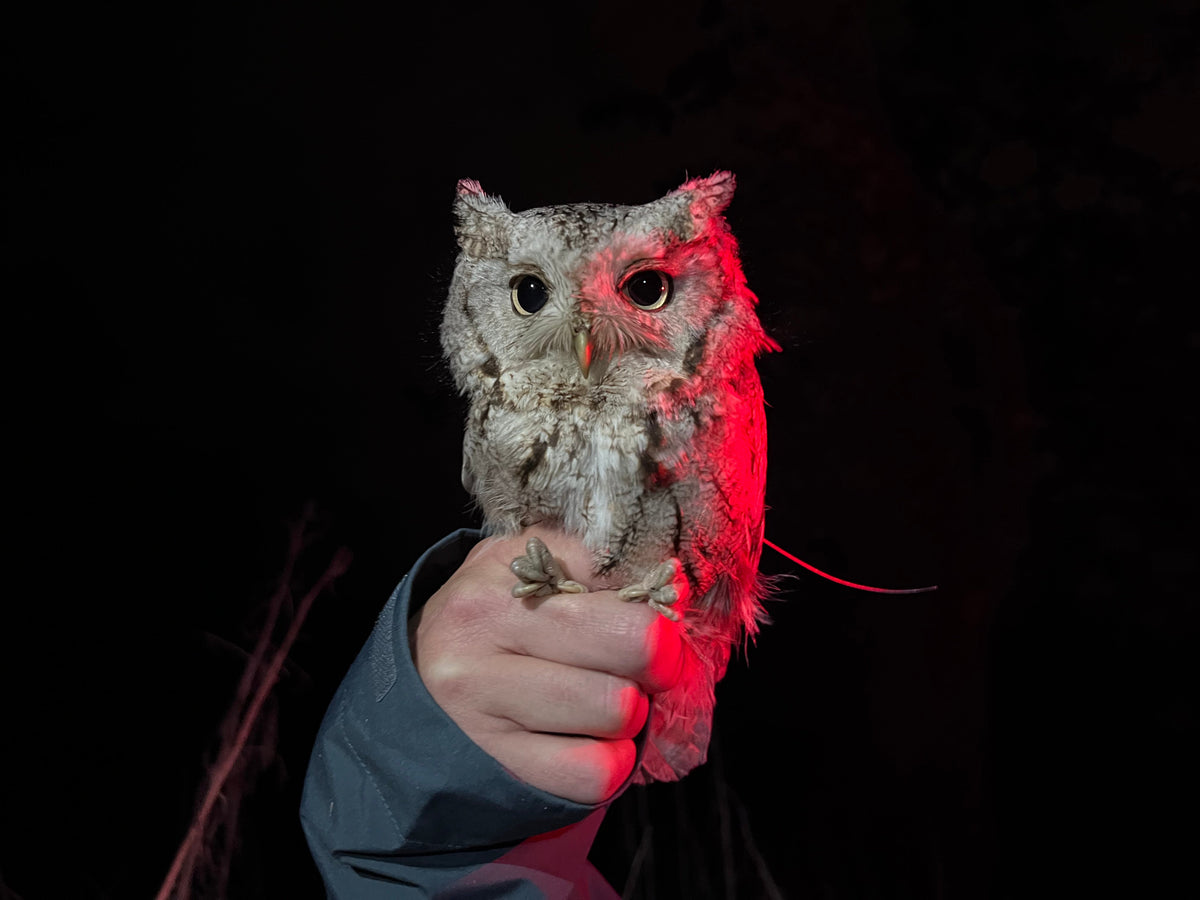
One of the owls tagged in 2026 was this male from the nest at Lee Martinez Park.
One of our favorite friends of Tellus is Marion Clément. We got to know Marion through the Bird Conservancy of the Rockies and she’s been an amazing partner from our beginning. In November 2025, we hosted the launch of the Urban Owl Nest Box Project and it was a hit!
Since then, more than 130 nest boxes have been installed to study Eastern Screech-Owls in Northern Colorado with help from local citizen scientists. We’re welcoming Marion, the Bird Conservancy of the Rockies and The Rocky Mountain Raptor program with Tycho the screech owl back to the store Dec. 3 to give us an update.
In anticipation of this event, we took this opportunity to get to know Marion better and learn about her Adventure With Purpose.
What inspired you to work with owls?
Early in my career, I was fortunate enough to be taken out to check Barn Owl nesting boxes with a state wildlife biologist. There was a sleepy female owl in one of the boxes, and when we took her out to band her as part of a nest box occupancy study, the biologist gently placed her in my hand. I was mesmerized, just like so many others are, by her beauty and mystery. It felt like I was holding an alien creature right here on Earth. I knew right then and there that I wanted to be an owl biologist, and I've been working with them ever since.
What's something about owls that most people would be surprised to learn?
They're actually very understudied! For how charismatic and fascinating they are, there are surprisingly few people out there studying them, which means there's still so much we don't know. For example, of Colorado's 12 regularly occurring owl species, five are considered "Species of Greatest Information Need" by our state wildlife agency, and two more are threatened. We have so much left to learn about these incredible birds!

Project lead Marion Clement holds a red-morph of an Eastern Screech-Owl.
How did you get involved with the Bird Conservancy of the Rockies?
I was very lucky. I had recently moved to the Rocky Mountain region and was really interested in working for Bird Conservancy. I initially applied for a Habitat Biologist position to get my foot in the door, even though I was more interested in research-type of positions. Before a decision was made, however, a staff member who had been leading our Mexican Spotted Owl work retired, so I switched my application to that position. When I was offered the job, it was a dream come true for me.
What lead you to focus on Mexican Spotted Owls?
I had recently finished my master's thesis on Barred Owls out east, which are close relatives of Spotted Owls. The two species are very similar, although the Mexican Spotted Owl is threatened. My position at Bird Conservancy was my first opportunity to work with Spotted Owls, but much of my previous experience translated well, including my willingness to work in challenging nighttime conditions.
What inspired the creation of the Urban Owl Nest Box Project?
I know how much people care about owls and want to help them. What many people don't realize is that a few simple steps can make it possible for these amazing creatures to take up residence right in our neighborhoods.
Owls have a way of changing how people see their own backyards. Instead of viewing them simply as recreation areas for families and pets, people begin to see the potential for a thriving backyard oasis filled with birds, insects and native plants. I wanted to give our community a way to give back to owls and contribute to research, all while welcoming more urban wildlife into their neighborhoods.

Dirk, one of the amazing BCR volunteers, and his daughter Madeline have built 24 boxes for the project.
Why is this project important for owls and their habitats in Northern Colorado?
The Front Range is developing rapidly, and we need to find ways to make space for wildlife in our neighborhoods to help mitigate some of the impacts of that growth. People find so much joy in wildlife sightings and often report feeling happier when their neighborhoods are filled with the critters they love.
By studying how we can help urban screech owls thrive alongside us, we're also learning how to better welcome and protect wildlife throughout our increasingly developed landscapes.
It's been a year since we introduced the project at Tellus. What has happened over the past year?
So much! I can't believe how far we've come. We've distributed 183 nest boxes along the Front Range, from Colorado Springs to Fort Collins. About 130 are already installed and waiting for owls to find them.
We've also raised more funding than we initially expected through box sponsorships, enough to support two years of the project and purchase several high-tech GPS tags. We've located five natural nests in our community and tracked three nesting owls.
Our community has grown tremendously, too. We now have a team of 20 dedicated volunteers helping us build boxes, and we've partnered with New Belgium Brewing to build even more. We've engaged five elementary and middle schools that monitor our boxes and incorporate them into their student learning activities.
On the research side, we've partnered with Colorado State University to analyze DNA from owl pellets and to deploy recording units to detect owls throughout our neighborhoods. It's been an incredible first year!

Map showing where nest boxes have been placed since the project began in Nov. 2025.
Have there been any exciting discoveries, surprises, or memorable moments?
It has been amazing to start working with our urban screech owls and see just how unfazed they are by our presence and everyday activities. They are not timid by any means!
The first owl we trapped was nesting in a yard with two very active dogs and a chicken run. The resident even reported having owls hunt around him while he was grilling! During our trapping efforts, the neighbor was running a leaf blower and someone else was jumping on a trampoline. The owl was completely unfazed and just went about its business. It was incredible to witness just how adaptable they can be.
How do you measure success, and what have you learned so far?
Success for this project has two parts. The first is what we learn through our research and how we can apply that knowledge to conservation. This goal is still a work in progress. It's a relatively new project, and we need to collect much more data before we can start drawing conclusions.
The second goal is inspiring people to think of their backyards and neighborhoods as places where they can welcome wildlife through small conservation efforts, like installing a nest box. In that regard, the project has already been a huge success. The incredible interest and support we've received are a testament to how much people connect with this message.
What is next for the project?
We'll keep growing our community of nest box stewards and moving the science forward by studying owls in both nest boxes and natural cavities, and tracking where more owls hunt, roost and nest. We also want to continue to develop new partnerships throughout our community to help promote this work.

At the Tellus event last year, Tycho the eastern screech owl (an education bird from Rocky Mountain Raptor Program) seems to like one of our boxes
How long have you been involved with bird conservation?
I've been involved ever since that Barn Owl was first placed in my hand (see the first question!), which was 11 years ago now.
Are you from Colorado? If not, where are you from originally?
I'm not originally from Colorado, but I very much consider this state home. My family is here, too, and I don't plan on leaving. I love it here! I'm originally from France and moved to the States with my family when I was 10.
What are some of the challenges that you face in your work?
Unfortunately, funding is our biggest challenge. We need people and organizations to support this work, and that's becoming increasingly difficult with diminishing federal funding and so many people struggling with the rising cost of living.
We have so many dedicated people ready to put in the hard work, but not always enough funding to make it all happen. That's why support from our local community is so important to the Urban Owl Nest Box Project. Every contribution helps us keep the research moving forward and give these owls a better chance to thrive.

A workshop held by New Belgium employees to donate boxes to the Owl Next Box Project.
How can local communities and individuals help protect owls and other birds?
Beyond providing financial support, there are plenty of things people can do right at home. For example, most people don't realize that outdoor lighting at night can be a huge detriment to owls and migratory birds. Many birds rely on stars to navigate at night. If light pollution makes it difficult for us to see the stars, imagine how it affects the birds trying to navigate by them!
Another important way to reduce our impact on owls and other birds of prey is to avoid rodenticides (poisonous rodent bait) at all costs. These poisons can kill owls, hawks, eagles and other wildlife, including raccoons and foxes.
There are plenty of other ways to help: keep cats indoors, plant native species to support pollinators and other wildlife, and reduce the risk of birds colliding with your home's windows. Small changes at home can make a real difference for the wildlife around us.
What drives you to focus on conservation?
I can't imagine a world I'd be happy living in without the incredible diversity of wildlife around me. There are so many of us on this planet, and I think it's important that we do what we can to keep our wildlife, habitats and plants healthy. They make our world beautiful, fascinating and worth protecting.
What does Adventure With Purpose mean to you?
I feel extremely lucky that I get to Adventure With Purpose for work every day. I love the places I get to see and the people I get to meet through my work in owl conservation.
When I'm out recreating on my own time, I try to live by those same values as much as I can. I reduce my impact on the landscape by practicing Leave No Trace and look for ways to continue conserving the places I love, helping protect them for future generations.
Holiday Gift Guide 2026